Service · Security
AI-Assisted Security Review for Small Businesses
We find the gaps attackers try first, explain them in plain English and help you close them, with a senior engineer checking every finding.
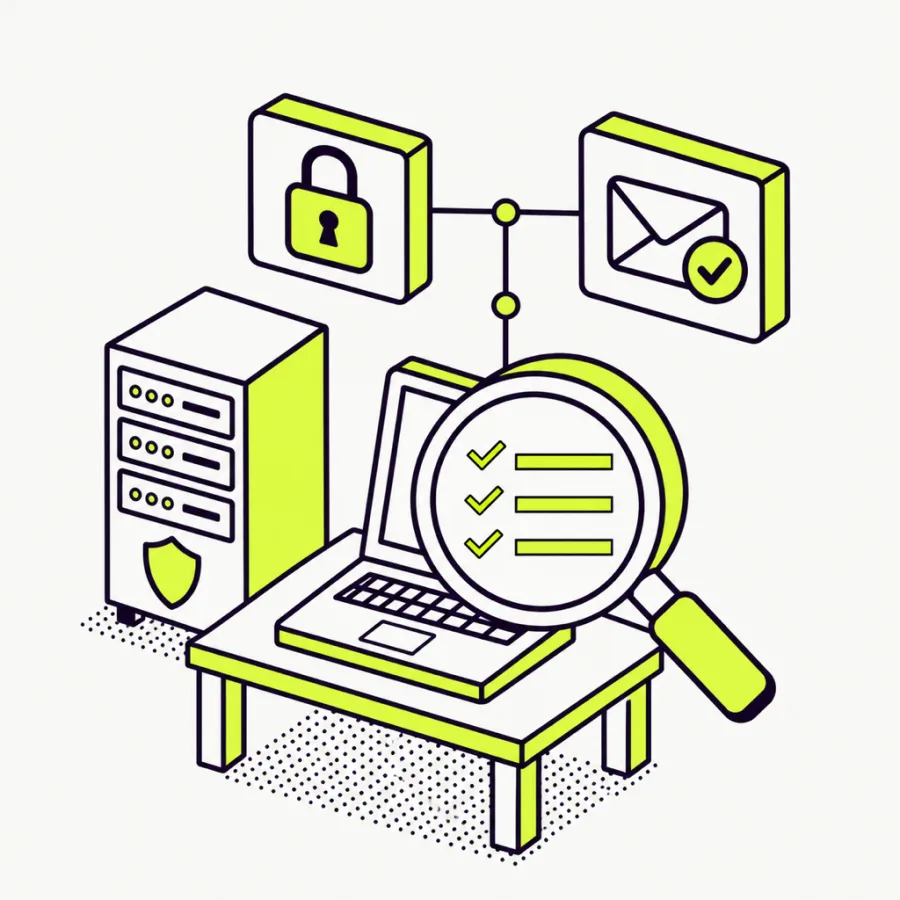
Why now
AI has made it cheaper to find software flaws and quicker to exploit them, and phishing emails now read like they came from a colleague. Large companies have security teams to keep up. Most small businesses have an IT person, a provider, or nobody.
The good news is that most breaches still start with a short list of basics. A review that checks those properly, and a plan to fix them in order, removes most of the easy ways in.
What we check
- Internet-facing systemsFirewalls, VPN and remote access, websites and exposed services, checked for known exploited flaws and out-of-date software.
- Email and sign-inMulti-factor sign-in, admin accounts, password reuse risk, and the SPF, DKIM and DMARC records that stop others sending email as you.
- Microsoft 365 or Google WorkspaceYour settings compared with published secure baselines, read-only.
- Devices, patches and backupsPatch status from the tools you already use, and whether backups are kept apart from your network and have actually been restored.
- AI tools and agentsWhich AI tools your team uses, what data goes into them, and what files and inboxes an AI assistant or agent can reach.
Who it's for
Businesses without a security team, especially those facing a cyber insurance application, a customer security questionnaire or a supplier certification.
What you get
- A review of your internet-facing systems, email and cloud settings, under a written authorisation you sign
- A check of the AI tools your team already uses: what data goes into them and who can see what
- A plain-English fix list in priority order, mapped to recognised baselines for small organisations
- Help patching and hardening the top items, alongside your IT person or provider
- Dated records of what was checked and fixed, for your insurer or a customer questionnaire
How it's priced
A fixed fee for the review, agreed before work starts. Fixes are quoted from the findings; monthly monitoring is optional.
How it works
- Agree scope in writingWe agree which systems we may check and how. Nothing runs until you've signed a written authorisation.
- ReviewAI tools scan and compare your settings with security baselines. A senior engineer checks every finding and removes the false alarms.
- FixWe work through the top items with your team or IT provider and record each change.
- Keep watchOptional: a monthly check for new flaws in the software you run, with a short report.
What stays with people
- A senior engineer reviews every finding before you see it
- Nothing changes on your systems without your approval
- Your team or IT provider stays in charge of your systems; we work alongside them
- We tell you plainly when you need a specialist we're not, such as a formal penetration test or an incident response firm
Questions
How can a small business check its security now that AI is finding software flaws faster?
Start with the gaps attackers try first: internet-facing systems that are behind on patches, email accounts without multi-factor sign-in, admin accounts, untested backups and files shared too widely. A security review checks those against a recognised baseline and gives you a short, ordered fix list.
Why does AI change our security risk?
AI makes it faster and cheaper to find and exploit known software flaws, and to write convincing phishing emails. Most small-business breaches still start with the basics: an unpatched system, a reused password, an email account without multi-factor sign-in. We check those first.
Is this a penetration test?
No. It's a review of the ways small businesses most often get breached. If your insurer, a customer or a certification asks for a formal penetration test, we'll say so and help you scope one.
Do you need access to our systems?
Read-only access for the review, under a written authorisation that names what we may check. We don't keep copies of your business data, and every change is made with your team and recorded.
Can this help with our cyber insurance application?
Yes. The fix list covers the controls insurers usually ask about, such as multi-factor sign-in, endpoint protection and tested backups, and you keep dated records of each. The insurer's decision is still theirs.
Is it safe to connect AI assistants to our email and files?
It can be, once permissions are right. An AI assistant sees whatever the signed-in person can see, so files shared too widely become easy to find. We check sharing and permissions before you switch it on.
Will this make us unhackable?
No one can honestly promise that. The review closes the gaps attackers try first and gives you a plan for the rest.
AI services
Five ways to put AI to work

AI Training
We teach your team to build and run their own AI agents — so the know-how stays in-house.
→02Guided setup
Agent Setup
We set up your first AI agent alongside your team, then hand it over with everything you need to run it.
→03Build
AI Development
We design and build a production AI agent or automation to your requirements, at a fixed price, and hand it over.
→04Build & maintain
AI Employee
We build an AI employee for a defined role in your business and keep it working for a monthly fee.
→05Embedded capacity
AI Team
Senior AI engineering capacity on retainer — building what a new hire would build, without the hire.
→Not sure where to start?
Request a free discovery session. We'll look at your work together and tell you plainly where AI would help — and where it wouldn't.